Ask most homeowners what does a mold inspection consist of and they will describe a lab test. They saw something dark on a basement wall or behind a bathroom vanity, they typed “black mold” into their phone, and by the time we talk they want me to come out, take a sample, and tell them whether it is the dangerous kind.
That is not what a mold inspection is. It is not even close, and the gap between what people expect and what actually happens is why so many homeowners in Point Pleasant Boro and Wall Township end up paying for the wrong thing.
What does a mold inspection consist of on a Jersey Shore house
The short version: it is a moisture investigation with sampling attached to the end of it, not a lab test with a walkthrough attached to the front.
Mold is not mysterious. It is a fungus, and it needs one thing you can control and several you cannot. It needs water. Take the water away and it stops. That is the entire mechanism, and it is why the bulk of my time on a mold and air quality visit is spent hunting for where water is getting in or where it is condensing, rather than staring at the stain everybody is worried about.
So the visit runs in this order.
I walk the exterior first, because a surprising share of interior mold starts outside. Grade sloping back toward the foundation. Downspouts dumping at the corner of the house instead of six feet out. Mulch piled against the siding so the bottom course never dries. On the Jersey Shore I am also looking at how the house handles wind-driven rain, because a coastal storm pushes water at a wall from a direction the builder may not have planned for.
Then I go inside with a moisture meter. This is the part that separates a real inspection from a guess. A pin meter reads the actual moisture content of the wood or drywall, and the number matters more than the color of the stain. Anything reading above roughly twenty percent is wet enough to support fungal growth. Below that, the material is not going to grow anything no matter how ugly it looks.
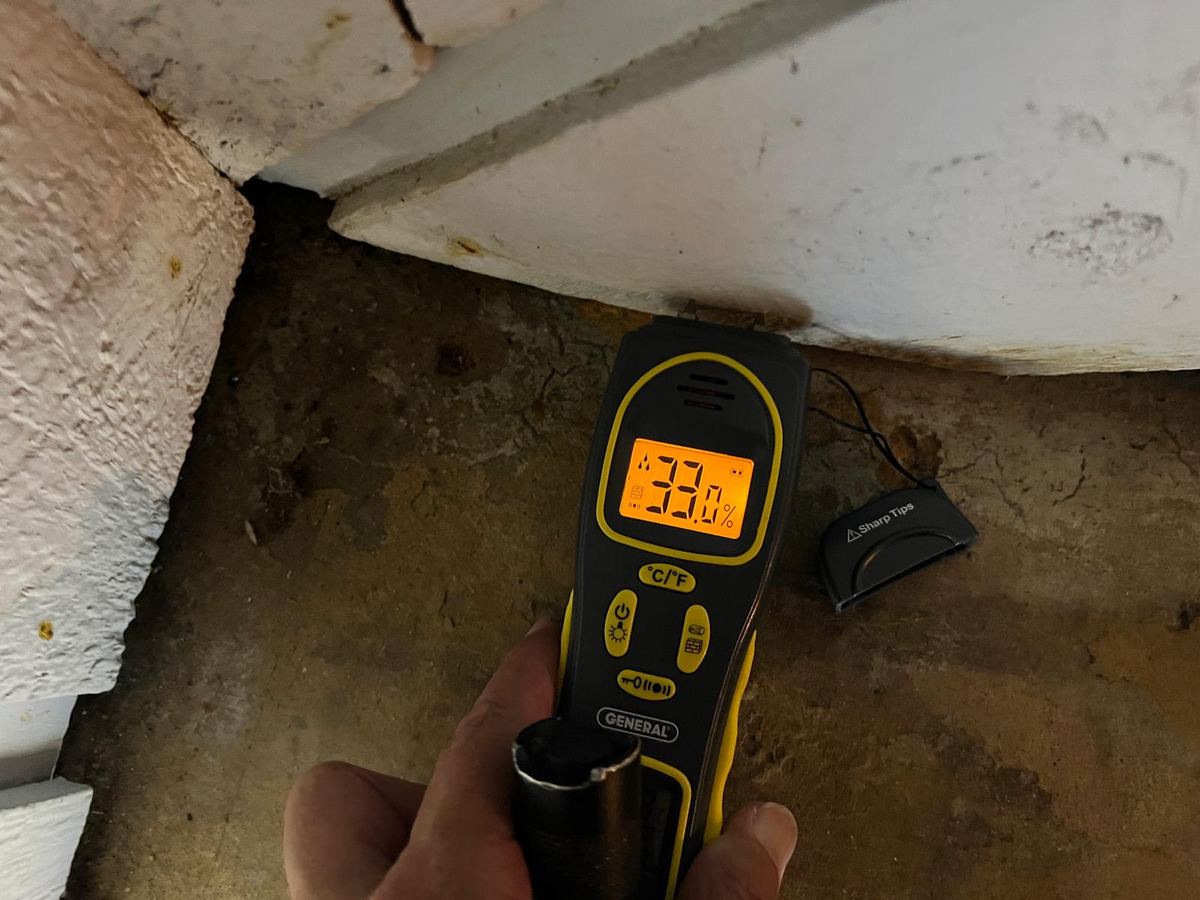
That distinction saves people money constantly. I have looked at plenty of dark staining that read bone dry, which tells me it is old, the source is already gone, and the homeowner needs a cleanup and a coat of paint, not a remediation contract.
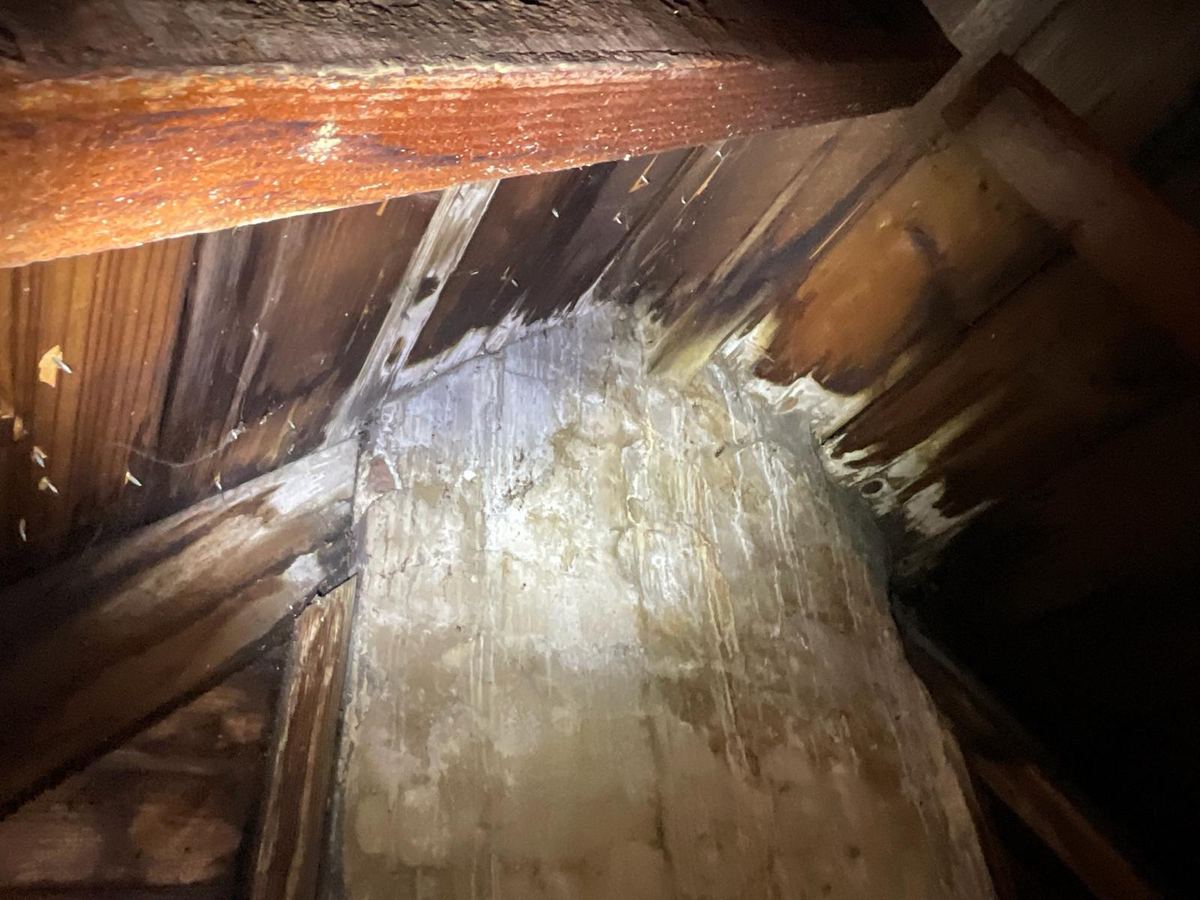
I check the attic, because attics are where I find the most mold in this county and where homeowners almost never look. Bathroom fans venting into the attic instead of through the roof. Insulation blocking the soffit vents so the space never breathes. In winter, warm moist air hits cold sheathing and condenses right on the underside of the roof deck.
I check the crawlspace, the basement, under every sink, around the washer, behind the refrigerator, and at every window where the trim meets the wall. And I look at how the house is being run: humidity levels, whether a dehumidifier is present and actually draining, whether the HVAC filter has been changed this decade.
Sampling comes last, and only if it will change what somebody does next. A surface sample lifts material from a specific spot. An air sample runs a pump for a set time and compares the indoor spore count to an outdoor control taken the same day. Both go to a lab. Neither one tells you where the water came from, which is why sampling without the walk is close to useless.
The New Jersey thing almost nobody mentions
Here is the fact that should change how you shop for this. New Jersey has no state license or certification for mold inspectors.
That is not an oversight in my reading of it. The Department of Health says plainly that there are no state certification programs for companies performing mold or indoor air services, and that any list it publishes is not an endorsement. Bills to create a certification program through the Department of Community Affairs have been introduced in Trenton more than once and have not become law.
So when a company tells you it is “certified” for mold work in New Jersey, that certification came from a private training organization, not from the state. Some of those are rigorous. Some are a weekend and a fee.
Two practical consequences.
First, ask what the person is actually going to do, not what card they carry. If the answer does not include a moisture meter and a look at the attic and the exterior grading, you are buying a sample, not an inspection.
Second, watch for the conflict. The proposed New Jersey legislation would ban the same contractor from inspecting a property and then remediating it, which tells you the legislature sees the problem clearly. A company that finds the mold and also sells the cleanup has a reason to find a lot of mold. I do not do remediation. I have no stake in how big the number is, which is the whole point of hiring an inspector rather than a contractor.
What you should do with the result
If you are under contract on a house in Manasquan or Brielle and something came up, the useful outcome is not a spore count. It is a written answer to three questions: where is the water coming from, how far has it gone, and what has to happen in what order. A remediation done before the leak is fixed is money set on fire.
If you already own the house, same three questions. Fix the source, dry it out, then clean up what grew.
Common questions
Is a mold inspection free? Be careful with the ones that are. A free mold inspection is almost always offered by a remediation company, and the inspection is the sales call. An independent inspection is a paid service because the deliverable is the finding, not the follow-up work.
What does a mold inspection cost in NJ? It depends on the size of the house, how many areas are in question, whether a crawlspace or attic needs to be entered, and how many lab samples the situation actually calls for. A single-room complaint in a ranch is a different job from a whole-house evaluation with an air sample and an outdoor control. Call and describe what you are seeing and I will tell you what the visit would involve.
Does a standard home inspection include mold testing? No. A general home inspection covers the systems of the house and will note visible moisture problems and suspected fungal growth, but sampling is a separate service you add on. If mold is a real concern for you, say so when you book.
Is mold testing required in New Jersey? No state law requires it for a residential sale. It comes up because a buyer asks for it, an inspection turned something up, or a lender or insurer wants it addressed.
Getting a straight answer about your house
I cover Point Pleasant Boro, Wall Township, Manasquan, Brielle, Spring Lake, Sea Girt, Red Bank and the rest of Monmouth County, and I do inspections without the drama: no scare tactics, no inflating a stain into a crisis, no talking you out of a real problem either. Reports come back within 24 hours.
If you have something you want looked at, call me at 732-800-2318 and tell me what you are seeing. If it turns out to be a dry stain and a leaky window, I will tell you that too.