
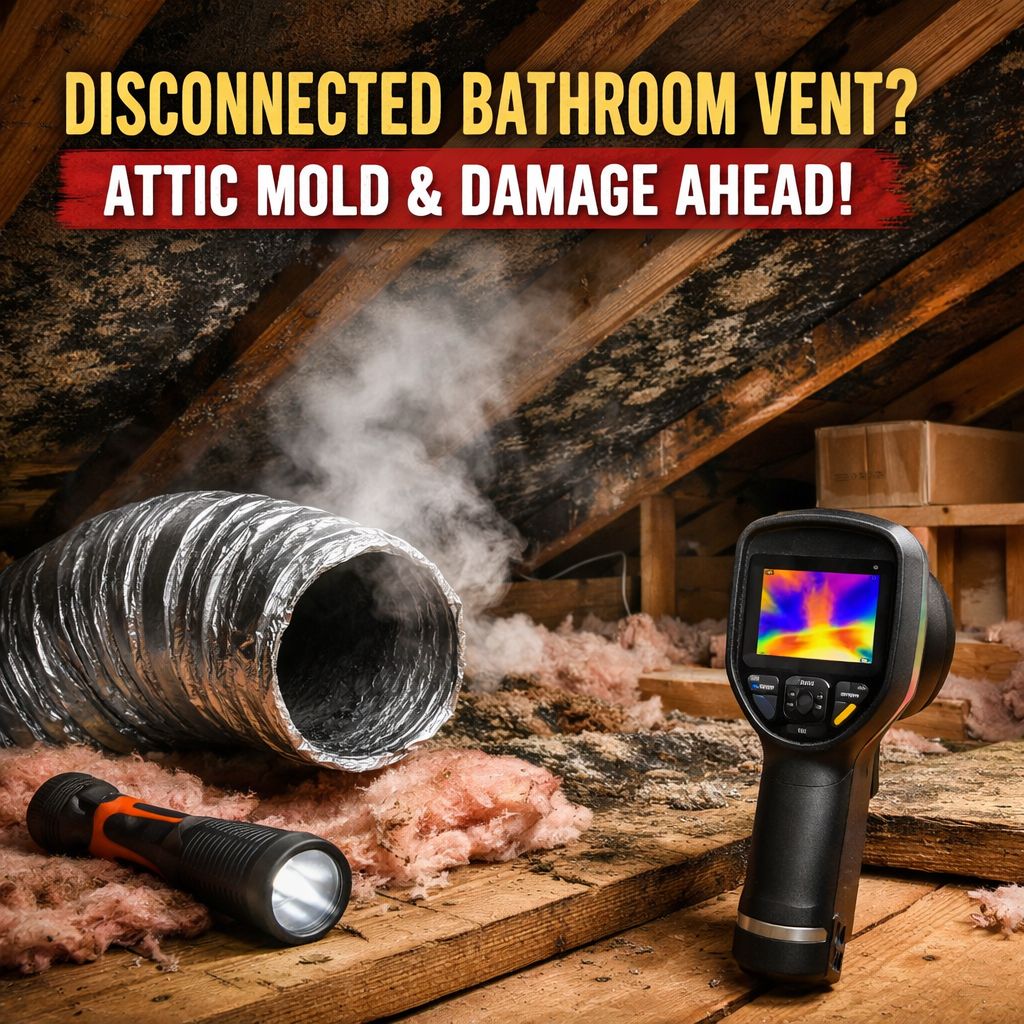
A disconnected bathroom exhaust vent in the attic dumps warm, humid air directly into an unconditioned space — causing wood rot, mold growth, and insulation damage that most homeowners never discover until it’s a costly repair. This defect is found in a significant number of homes we inspect across Fairfield County, CT and Westchester County, NY, and it is almost always invisible from inside the living space.
What Is a Disconnected Bathroom Exhaust Vent?
Every bathroom exhaust fan is designed to pull humid air out of the bathroom and route it through a duct to the exterior of the home — typically through the roof, a soffit, or a gable wall. The problem: that duct runs through the attic, and in many homes, the flexible duct has pulled loose from its connection point. The fan still runs. The bathroom still sounds like it’s working. But the moist air is now dumping directly into the attic cavity.
Homeowners almost never catch this because they never go into the attic. The fan sounds normal. There are zero visible signs inside the bathroom. The defect stays hidden for months or years.
Why This Matters: Moisture, Mold, and Structural Damage
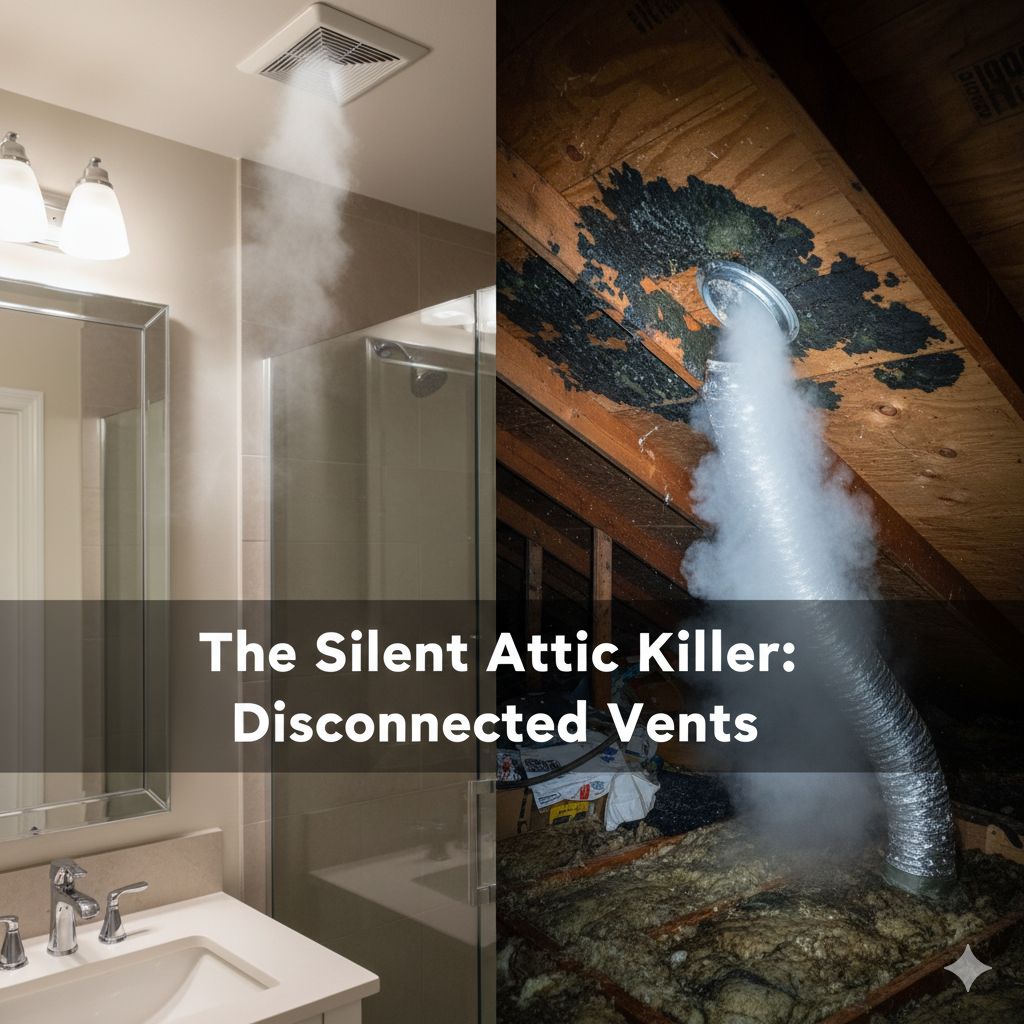
An attic is an unconditioned space — it is not heated or cooled. When warm, humid air from a hot shower enters the attic, it hits cold roof sheathing and framing members and immediately condenses. Repeat this daily for a year and the consequences compound fast:
- Mold and mildew growth on roof sheathing, rafters, and insulation — a defect we document in detail in our Fungal Damage Awareness guide
- Wood rot on structural framing components
- Degraded insulation — wet insulation loses its R-value and becomes a medium for biological growth
- Elevated attic humidity that can migrate into the living space, contributing to indoor air quality issues detectable through professional mold air testing
In the climate of Fairfield County, CT and Westchester County, NY, where winters are cold and bathroom use is year-round, the temperature differential between bathroom air and attic air is severe. The EPA’s guidance on indoor mold confirms that condensation on cold surfaces is one of the primary drivers of mold colonization — and an unvented bathroom duct is a direct, recurring source.
The Insulation Problem Nobody Talks About
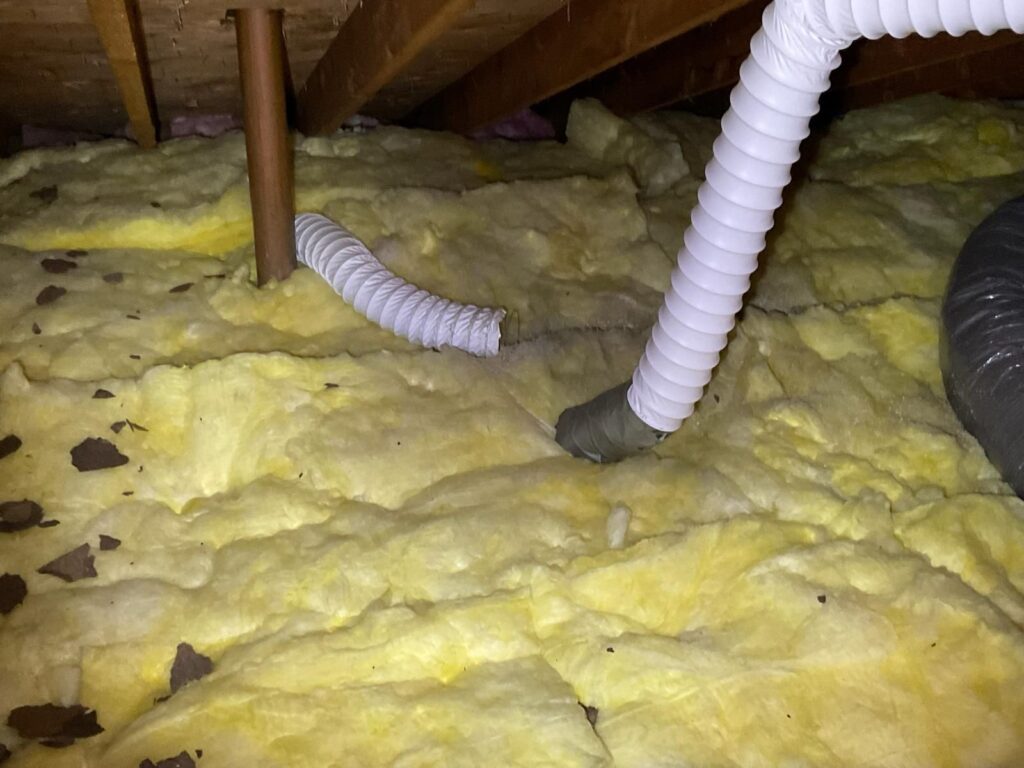
Even when a bathroom exhaust duct is properly connected and routed to the exterior, there is a second issue that goes unaddressed in most homes: the duct itself is uninsulated.
When warm, humid exhaust air travels through a cold, uninsulated flex duct in a cold attic, condensation forms inside the duct. Over time, that moisture drips back toward the fan or pools inside the duct. The fix is straightforward — the duct should be wrapped in insulated flex duct (R-6 or better) — but it is frequently omitted during original installation or not addressed during renovations.
How a Home Inspector Finds This Defect
This is a textbook example of why attic access and inspection matters. During a Nearwater Property Group home inspection, the attic is examined as a standard part of the scope — not skipped because it’s inconvenient. We use thermal imaging alongside visual inspection to catch moisture that the eye alone can miss. We are specifically looking for:
- Duct terminus: Does the exhaust duct terminate at the exterior, or does it dead-end or disconnect inside the attic?
- Duct condition: Is the flexible duct kinked, compressed, torn, or separated at either end?
- Insulation: Is the duct insulated to prevent condensation in the duct run?
- Evidence of prior moisture: Staining, mold, or deterioration on roof sheathing near where a duct terminates
This defect shows up in new construction and older homes alike. It is not a function of home age — it is a function of whether anyone has looked.
What Buyers and Sellers in Fairfield County and Westchester Need to Know
For buyers: If your inspection report flags a disconnected or uninsulated bathroom exhaust duct, treat it seriously. The duct itself is a minor repair. The downstream damage — mold remediation, sheathing replacement, insulation removal — is not.
For sellers: A pre-listing inspection that identifies this issue lets you correct it before buyers and their inspectors find it. A disconnected duct discovered during a buyer’s inspection becomes a negotiation point. One corrected before listing does not.For current homeowners: If you cannot remember the last time someone looked in your attic, that is the only information you need to schedule an inspection. This is a ten-minute attic check that can prevent a five-figure remediation.
Next Steps
| Action | Priority | Notes |
| Schedule a home inspection with attic access | High | Required to confirm duct connection and condition |
| Verify duct terminates at the exterior | High | Must exit through roof, soffit, or gable — not terminate in attic |
| Insulate existing duct runs | Medium | R-6 insulated flex duct is the standard correction |
| Check for attic moisture / mold evidence | High if defect existed | Look for staining or biological growth on sheathing near duct |
| Pre-listing inspection before selling | Recommended | Correct before buyer’s inspector flags it |
Nearwater Property Group serves Fairfield County, CT (Norwalk, Stamford, Greenwich, Darien, New Canaan, Westport, Wilton, Fairfield) and Westchester County, NY (Rye, Larchmont, Mamaroneck, Harrison, Scarsdale). Call (203) 219-4034 or visit nearwaterpgllc.com to schedule.