
Wood siding installed all the way to the ground is one of those defects that looks harmless and causes serious damage. No gap between the siding and the soil means moisture gets in, pests get in, and neither one announces itself until the repair is already expensive.
The International Residential Code requires a minimum of six inches of clearance between wood siding and the ground. That gap isn’t decorative — it’s the difference between a wall that breathes and one that slowly rots from the bottom up.
What Wood Siding Ground Clearance Actually Is
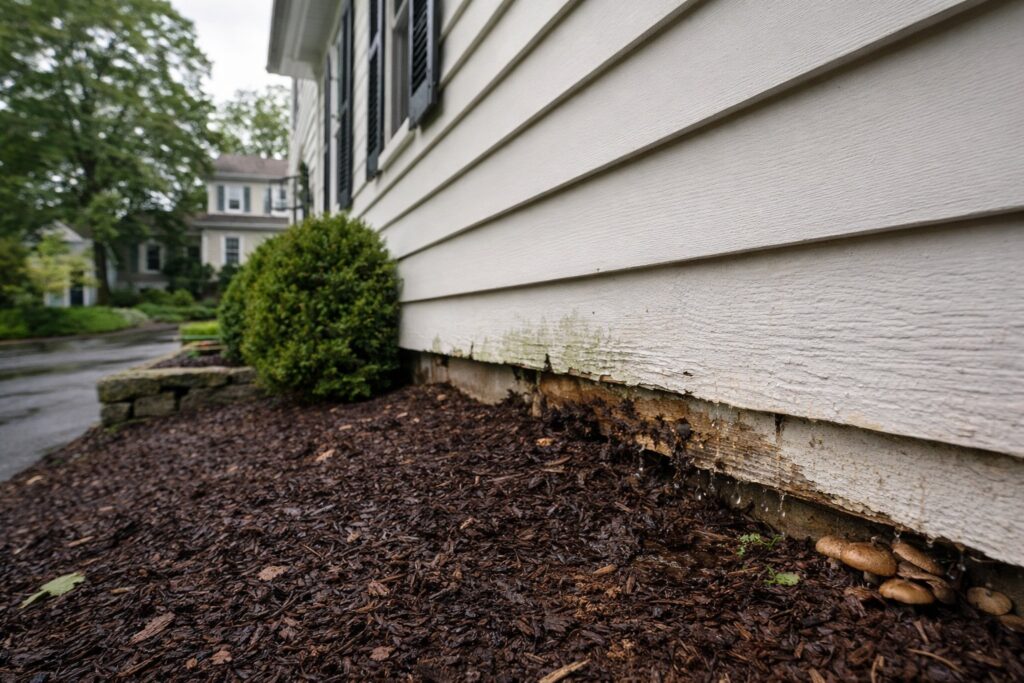
Ground clearance is the vertical gap between the bottom edge of your exterior siding and the surface of the soil. On a properly built home, you’ll see a visible band of foundation wall between where the siding ends and where the ground begins.
That gap needs to be at least six inches for wood siding. It’s not a suggestion — it’s a building code requirement based on how moisture behaves around wood at ground level.
When that gap disappears, the wall loses two of its most important protections: the ability to dry out after rain, and a visible inspection zone where pest activity shows up before it becomes structural damage.
Why It Matters
Soil stays damp long after a rainstorm. Wood that sits close to moist ground absorbs water continuously — and wood that stays wet doesn’t behave like wood that dries and re-dries with the seasons. It softens. Fungi take hold. Decay starts.
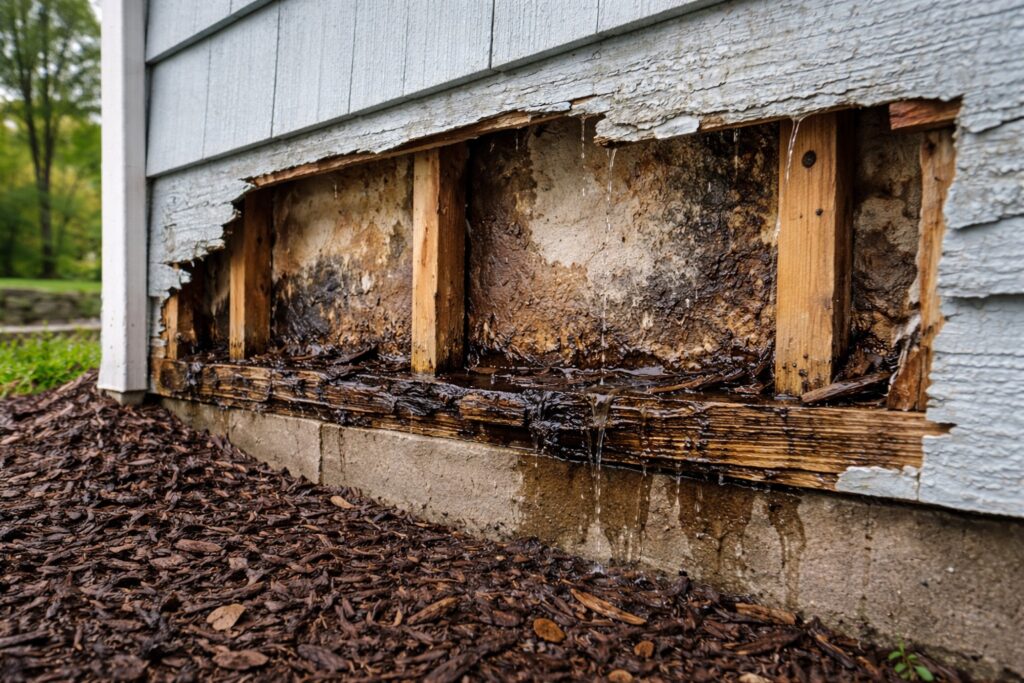
The damage doesn’t stay in the siding. Moisture works inward — through the building wrap, into the sheathing, into the wall studs, and eventually into the sill plate at the top of the foundation. By the time something looks wrong on the outside, the framing behind the wall has often been compromised for months or longer.
The pest risk is just as serious. Subterranean termites travel from the soil into wood through mud tubes built along foundation walls. When siding runs to grade, those tubes are hidden behind it. A colony can feed undisturbed for years without leaving a single visible sign.
The American Institute of Inspectors formally classifies insufficient siding clearance as a “conducive condition” — meaning a defect that actively invites wood-destroying organisms.
What Professionals Often See
Pattern recognition is one of the most useful things an experienced inspector brings to a property. With siding clearance, a few patterns show up again and again.
The most common is landscaping that has grown up over time. A home might have been built with correct clearance, but years of mulch applications and planted beds have raised the grade until the gap is gone entirely. The siding didn’t change — the ground came up to meet it.
The second pattern involves renovations. When new siding goes on or a wall gets extended, the bottom course can easily end up a few inches too low. The difference between compliant and non-compliant isn’t always obvious on a busy job site.
The third pattern, especially common across Fairfield County and Westchester County, is original construction that simply didn’t follow the rule. Homes built in the 1940s through 1960s weren’t always held to the clearance standards that exist today.
Signs You Might Notice
Walk the perimeter of the house and look at where the siding meets the ground. If there’s no visible foundation wall — if the siding appears to go straight into the soil or disappear into a mulch bed — that’s the first indicator.
At the base of the wall, look for:
- Paint that’s peeling or bubbling specifically at the bottom courses
- Siding boards that look slightly darker than the rest
- Wood that has a soft or spongy feel when pressed
- A slight outward bow along the bottom edge of the boards
- Pencil-width mud tubes running up the foundation face
- Fine sawdust-like frass near the base of the wall
Terminix notes that subterranean termites build mud tubes specifically to travel between soil and wood while staying protected from the open air. Those tubes, running up the foundation, are one of the clearest signs of an active infestation.
Why This Happens
The causes are worth understanding because they affect how the problem gets fixed.
Landscaping changes are the leading cause of clearance loss in established homes. Mulch, topsoil, planted beds, and natural grade settling all raise the effective ground level against the foundation — sometimes by several inches over a decade.
Improper installation puts the siding too low from day one. A contractor who isn’t paying close attention, or who is trying to conceal an unfinished section of foundation, can end up with siding that doesn’t meet code.
Foundation settling on sloped lots can gradually shift the relationship between grade and siding, particularly where erosion or soil movement is ongoing.
InspectApedia’s siding ground clearance reference makes an important point: all three causes are common enough that clearance should be checked at every exterior wall, not just the ones that look problematic.
Professional Insight
The right repair depends entirely on what’s found underneath the surface — and that assessment matters before any work begins.
If the clearance has been lost purely to landscaping, the fix can be simple: pull the mulch back, excavate the soil away from the foundation, restore the six-inch gap, and make sure the grade slopes away from the house. No siding work required.
If the lower courses of siding show surface damage, they need to come off, be replaced, and be reinstalled at the correct height. Moderate work, moderate cost.
If moisture has reached the sheathing or framing, the scope expands. A contractor will need to open the wall to assess and repair structural damage before new siding goes back on.
If there’s any evidence of pest activity, a licensed pest control professional should evaluate before repairs begin. Fixing the wood without addressing an active infestation is a short-term solution that doesn’t hold.
As the IRC commentary on wood decay protection makes clear, the six-inch gap exists because it’s the minimum clearance at which untreated wood can dry adequately. Below that threshold, the wall is working against the conditions that keep it intact.
Final Thoughts
Six inches of exposed foundation between siding and soil is a small measurement with a significant purpose. When it’s there, it’s doing its job. When it’s gone, the wall is on its own against moisture and whatever lives in the ground below.
Caught early, this is a manageable fix. Caught late — during a renovation, at a sale, or after visible structural failure — it becomes an expensive lesson. That gap between those two outcomes is exactly where a thorough inspection earns its value.
If you’re buying or selling a home in Fairfield County, CT or Westchester County, NY and want to know the real condition of the property before you commit, Nearwater Property Group is here to give you the full picture.
📞 (203) 219-4034 | tom@nearwaterpgllc.com | nearwaterpgllc.com
Available Monday–Sunday, 7:00 am – 10:00 pm. Serving Norwalk, Stamford, Greenwich, Darien, New Canaan, Fairfield, Westport, Wilton, Rye, Mamaroneck, Harrison, Scarsdale, and Larchmont.
ASHI Certified · Licensed in CT, NY & NJ · Every inspection exceeds State and National Industry Standards